Mebendazole and Cancer: What the New Mechanism Study Actually Shows
In June 2026, a research group at Boston College published something that had been missing from a fifteen-year story. Mebendazole, an anti-parasitic drug approved for human use in 1971, had been showing anticancer activity in laboratory models since 2011. What nobody had shown was how it interfered with one of the fuels cancer cells depend on. The new paper offers a mechanism, and mechanism is what moves a compound from an interesting observation into a research programme.
This article covers what that study did, the Johns Hopkins work before it, what the human trial record says, and where the evidence runs out. It is educational, not a protocol, and it contains no dosing guidance.
Key takeaways
◉ The June 2026 mebendazole study was conducted in juvenile mice and in cultured human glioma cells. There are no human results in it.
◉ Mebendazole reduced the metabolites produced when glutamine is burned, and reduced glutaminase C, the enzyme that opens that pathway.
◉ The benefit was measured against a ketogenic diet background. No group received mebendazole without the diet, so the study cannot separate the two.
◉ Johns Hopkins has published on mebendazole across several cancer models since 2011. The breast cancer work is about metastasis, not primary tumour growth.
◉ Human safety is established to 200 mg/kg per day, but no completed trial shows mebendazole helps people live longer, and one randomized trial missed its own benchmark.
◉ Mebendazole should not be combined with metronidazole, and it carries liver and drug-interaction considerations that require monitoring.
How cancer cells use glutamine as fuel
Cancer cells that cannot make energy the normal way ferment two fuels: glucose and glutamine. In many tumour cells the mitochondria, which normally generate energy using oxygen, are damaged or working poorly, so the cell ferments instead. Glucose is one fermentable fuel. Glutamine, the most abundant amino acid in blood, is the other. Cells break glutamine down through a pathway called glutaminolysis, running it to glutamate, then alpha-ketoglutarate, then succinate.
Restricting one fuel leaves the other available. Diet can push on the glucose side. The glutamine side is harder, because the compounds that target it well in the laboratory are not approved for human use. That asymmetry is why a finding about an approved, inexpensive drug attracts attention.
Evidence level 3. This is laboratory and animal work. It has not been shown to improve outcomes in people.
What the 2026 mebendazole and glutamine study found
The June 2026 study from Boston College reported that mebendazole reduced glutamine use in cultured cancer cells and reduced glutaminase C in tumour tissue, and that mice receiving mebendazole alongside a ketogenic diet survived longer than mice on the diet alone. All of it is preclinical.
How the study was designed
Juvenile mice were implanted with two mouse glioma models, one highly invasive and one not. Mebendazole and devimistat, an investigational metabolic agent, were given as intermittent pulses. A ketogenic diet ran continuously as the background condition. Both drugs were also tested against SF-188, a human paediatric glioblastoma cell line, in culture.
What mebendazole did
Mebendazole-treated mice on the ketogenic diet survived longer than mice on the diet alone. Metabolite analysis showed reductions in glutamate, alpha-ketoglutarate, succinate and lactate in treated cells, and reduced expression of glutaminase C in treated tumour tissue. Imaging mass spectrometry confirmed mebendazole reached brain tissue. The diet also allowed lower dosing, which the authors present as a toxicity advantage.
What the study cannot tell you
The authors state that they deliberately did not include a standard-diet plus mebendazole group, on the grounds that mebendazole requires dietary fat for meaningful absorption. This study therefore cannot separate how much of the effect belongs to the drug and how much to the diet. That comparison was made for devimistat, which showed no effect on the standard diet, but not for mebendazole.
Johns Hopkins mebendazole research, 2011 to today
Johns Hopkins has been publishing on mebendazole in cancer models since 2011, when a laboratory there observed that implanted brain tumours in their mice were failing to grow. The cause was traced to fenbendazole, a benzimidazole being used to control pinworm in the colony. The group tested family members against one another and carried mebendazole forward, because it is approved for human use.
The work since spans several tumour types. In two models of pancreatic cancer, mebendazole disrupted stromal desmoplasia, the dense fibrous tissue that shields a pancreatic tumour, and interfered with tumorigenesis. In breast cancer models mebendazole reduced metastasis to the lung and abolished metastasis to the liver, attributed in part to reduced ITGB4 expression and cancer stemness. A later paper found that mebendazole suppresses hypoxia-inducible factor signalling, associated with chemoresistance and metastasis, and is explicit that it did not significantly reduce primary tumour size. The breast cancer story is about spread, not about shrinking the original tumour.
Other reported mechanisms include tubulin disruption and mitotic arrest, inhibition of angiogenesis, apoptosis through Bcl-2 inactivation, and hedgehog pathway inhibition.
Mebendazole cancer clinical trials: what the human data shows
Mebendazole has been through several human trials in cancer. They establish that it is tolerable at high doses. None of them establishes that it helps people live longer, and the one randomized trial did not meet its own pre-set benchmark.
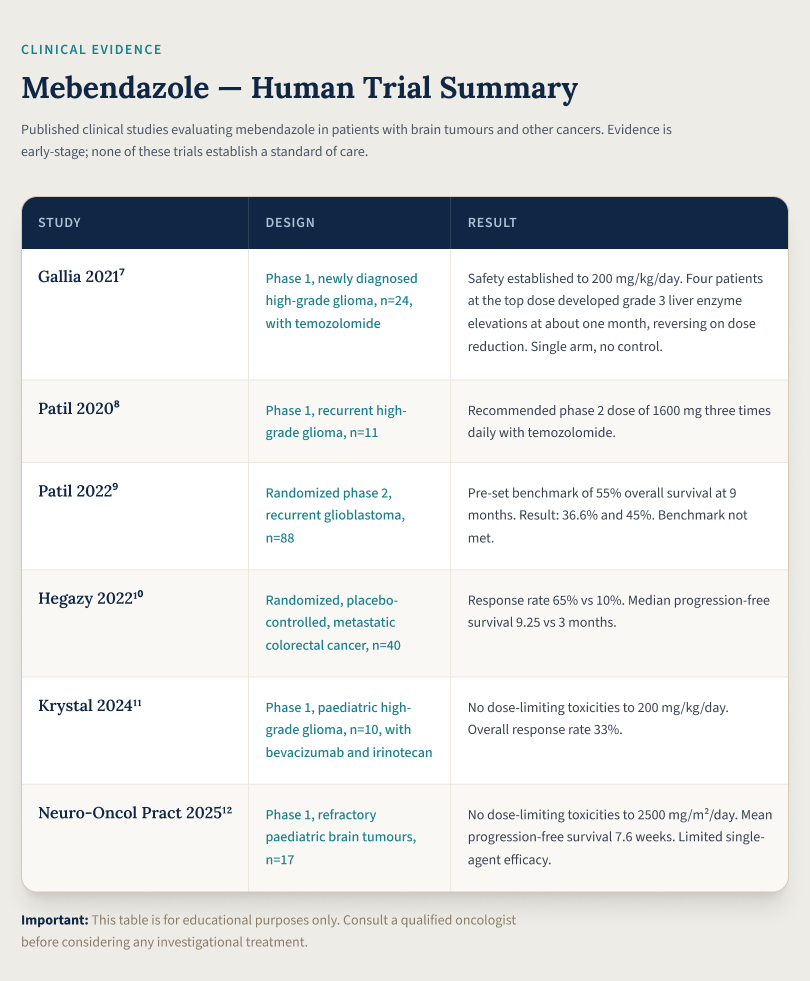
Two of those rows need reading carefully.
The Hegazy colorectal result is the strongest human finding for mebendazole, and it has a problem. A 10 percent response rate in the control arm is well below what first-line therapy normally produces in metastatic colorectal cancer, where published rates sit around 45 to 60 percent. A weak control arm inflates the apparent effect. The trial was single-centre, n=40, and has not been replicated.
The negative randomized trial also has a subgroup worth naming, in the interest of stating this evenly. In patients with better performance status, the lomustine arm reached 57.9 percent survival at nine months, and the authors wrote that it warrants further evaluation. That is a post-hoc analysis and cannot rescue a trial that missed its primary endpoint, but omitting it would be selective.
The summary position: mebendazole has established human safety at oncology doses and no completed trial demonstrating a survival benefit.
Mebendazole side effects and drug interactions
Mebendazole's most commonly reported adverse effect at oncology doses is reversible elevation of the liver enzymes ALT and AST. In the Hopkins phase 1, four of the fifteen patients at 200 mg/kg developed grade 3 elevations after about a month, which reversed with lower dosing or discontinuation. No elevated bilirubin was observed. Mebendazole is metabolised primarily by the liver, which matters when it sits alongside hepatically cleared chemotherapy.
Metronidazole is the sharpest named interaction. A case-control investigation of an outbreak among Filipino workers in Taiwan found an odds ratio of 9.5 for Stevens-Johnson syndrome and toxic epidermal necrolysis with combined use in the preceding six weeks. Neither drug alone showed the association in that study. Product labelling and standard interaction references advise avoiding concurrent use.
For proportion: a 2025 Danish national cohort found SJS/TEN following a mebendazole prescription at a frequency below one in 450,000 prescriptions. The combination signal is real and the baseline risk from mebendazole alone is very low. Both statements belong together.
Phenytoin and carbamazepine reduce mebendazole plasma levels through CYP3A4 induction. Cimetidine raises them.
Mebendazole is poorly soluble, and how much reaches the bloodstream varies substantially between individuals. Plasma levels in the Hopkins phase 1 were variable but rose with dose. That variability is an argument for monitoring by a prescriber, not for self-experimentation.
Where mebendazole is sourced: compounding pharmacy considerations
Mebendazole is a prescription medicine, so sourcing questions differ from those that apply to supplements. There is no over-the-counter version to compare brands of, and no third-party certification mark to look for.
What does vary is the pharmacy. In the United States, mebendazole for oncology use is usually dispensed by a compounding pharmacy rather than as a commercially manufactured product, and compounded preparations are not subject to the same FDA pre-market potency and stability review. The distinction that matters is between 503A pharmacies, which compound for an individual patient against a specific prescription, and 503B outsourcing facilities, which are FDA-registered and subject to current good manufacturing practice requirements.
Reasonable questions for any pharmacy filling this: whether they perform potency testing on finished preparations, what their beyond-use dating is based on, and whether they are 503A or 503B. Absorption already varies between individuals, and preparation variability adds a second source of uncertainty.
Neither the NutriLiv nor the MealGrove app recommends or vets specific commercial products, brands, or pharmacies, and nothing in this article should be read as doing so.
Why mebendazole has no phase 3 cancer trial
Mebendazole came off patent decades ago. No company can hold exclusivity on it, and none can recover the cost of a phase 3 trial, routinely hundreds of millions of dollars, on a molecule any compounding pharmacy can prepare. That is a structural feature of drug financing, not evidence that anyone is concealing anything, and it is why repurposing research leans on academic and philanthropic funding.
One illustration. The Hopkins group did secure a patent, not on mebendazole itself, which cannot be patented, but on a specific crystal form. Polymorph C reaches the brain in higher concentrations than other forms, and the patent, awarded September 2021, covers an oral formulation containing at least 90 percent polymorph C. That technology was licensed from Johns Hopkins to a commercial partner, and the senior investigator discloses a financial interest in the licensee.
None of that makes the science less real. The polymorph work addresses a genuine problem, since standard mebendazole is poorly absorbed and does not readily cross the blood-brain barrier. But it illustrates the incentive structure: the version of a drug that attracts funding tends to be the version somebody can own.
Mebendazole and cancer: common questions
Is mebendazole approved to treat cancer?
No. Mebendazole is approved for parasitic infections. Any anticancer use is investigational and off-label. It is not supportive care, which refers to managing symptoms and the side effects of treatment.
Is mebendazole the same as fenbendazole?
No. Fenbendazole is a veterinary drug with no human approval. Mebendazole is human-approved and has registered oncology trials. They are relatives in the same benzimidazole family, not equivalents, and evidence for one does not transfer to the other.
Does mebendazole work better with a ketogenic diet?
The June 2026 study cannot answer that, because no group received mebendazole without the diet. The diet was used in mice partly as a metabolic intervention and partly as a fat-containing vehicle for a poorly absorbed drug. Dietary changes during treatment carry real consequences for weight, muscle mass and treatment tolerance, and belong with your oncology team and a dietitian.
How do I ask my oncologist about mebendazole?
Bring the drug name, the interaction list, and a question about liver monitoring. A specific question is easier to answer than a general one, and it makes the conversation a clinical one rather than a debate.
Does Personalized Medicine prescribe mebendazole?
We provide integrative and metabolic care alongside standard oncology treatment, never in place of it. Whether mebendazole or any other approach is appropriate depends on your diagnosis, treatment plan and current medications, and that determination happens in a consultation, not in an article.
Who should not take mebendazole?
Anyone taking metronidazole, anyone with liver disease, and anyone whose current regimen already carries a liver burden. That determination requires a clinician who has your full medication list in front of them.
References
1. Mukherjee P, Maurer J, Stopka SA, et al., Seyfried TN. Cell Reports Medicine. 2026;7(6):102845. https://www.sciencedirect.com/science/article/pii/S2666379126002624
2. Bai RY, Staedtke V, Aprhys CM, Gallia GL, Riggins GJ. Antiparasitic mebendazole shows survival benefit in 2 preclinical models of glioblastoma multiforme. Neuro-Oncology. 2011;13(9):974-982. https://doi.org/10.1093/neuonc/nor077
3. Williamson T, de Abreu MC, Trembath DG, et al., Riggins GJ. Mebendazole disrupts stromal desmoplasia and tumorigenesis in two models of pancreatic cancer. Oncotarget. 2021;12:1326-1338. https://www.oncotarget.com/article/28014/text/
4. Joe NS, Godet I, Milki N, et al., Gilkes DM. Mebendazole prevents distant organ metastases in part by decreasing ITGB4 expression and cancer stemness. Breast Cancer Research. 2022;24:98. https://doi.org/10.1186/s13058-022-01591-3
5. Joe NS, Wang Y, Oza HH, Godet I, Milki N, Riggins GJ, Gilkes DM. Mebendazole treatment disrupts the transcriptional activity of hypoxia-inducible factors 1 and 2 in breast cancer cells. Cancers. 2023;15(4):1330. https://www.mdpi.com/2072-6694/15/4/1330
6. Guerini AE, Triggiani L, Maddalo M, et al. Mebendazole as a candidate for drug repurposing in oncology: an extensive review of current literature. Cancers. 2019;11(9):1284. https://doi.org/10.3390/cancers11091284
7. Gallia GL, Holdhoff M, Brem H, et al., Riggins GJ. Mebendazole and temozolomide in patients with newly diagnosed high-grade gliomas: results of a phase 1 clinical trial. Neuro-Oncology Advances. 2021;3(1):vdaa154. https://academic.oup.com/noa/article/3/1/vdaa154/5979487
8. Patil VM, Bhelekar A, Menon N, et al. Reverse swing-M, phase 1 study of repurposing mebendazole in recurrent high-grade glioma. Cancer Medicine. 2020;9(13):4676-4685. https://doi.org/10.1002/cam4.3094
9. Patil VM, Menon N, Chatterjee A, et al. Mebendazole plus lomustine or temozolomide in patients with recurrent glioblastoma: a randomised open-label phase II trial. eClinicalMedicine. 2022;49:101449. https://www.ncbi.nlm.nih.gov/pmc/articles/PMC9156991/
10. Hegazy SK, El-Azab GA, Zakaria F, Mostafa MF, El-Ghoneimy RA. Mebendazole; from an anti-parasitic drug to a promising candidate for drug repurposing in colorectal cancer. Life Sciences. 2022;299:120536. [LINK TO VERIFY BEFORE PUBLISH]
11. Krystal J, Hanson D, Donnelly D, Atlas M. A phase 1 study of mebendazole with bevacizumab and irinotecan in high-grade gliomas. Pediatric Blood and Cancer. 2024;71:e30874. https://doi.org/10.1002/pbc.30874
12. Phase 1 study of mebendazole therapy for refractory, progressive or recurrent paediatric brain tumours. Neuro-Oncology Practice. 2025;npaf060. https://doi.org/10.1093/nop/npaf060
13. Chen KT, Twu SJ, Chang HJ, Lin RS. Outbreak of Stevens-Johnson syndrome/toxic epidermal necrolysis associated with mebendazole and metronidazole use among Filipino laborers in Taiwan. American Journal of Public Health. 2003;93(3):489-492. https://pubmed.ncbi.nlm.nih.gov/12604501
14. Heerfordt IM, et al. Risk of Stevens-Johnson syndrome and toxic epidermal necrolysis associated with mebendazole use. Basic and Clinical Pharmacology and Toxicology. 2025. https://onlinelibrary.wiley.com/doi/10.1111/bcpt.70086
15. Bai RY, Staedtke V, Wanjiku T, Rudek MA, Joshi A, Gallia GL, Riggins GJ. Brain penetration and efficacy of different mebendazole polymorphs in a mouse brain tumor model. Clinical Cancer Research. 2015;21:3462-3470. https://doi.org/10.1158/1078-0432.CCR-14-2681